Abstract
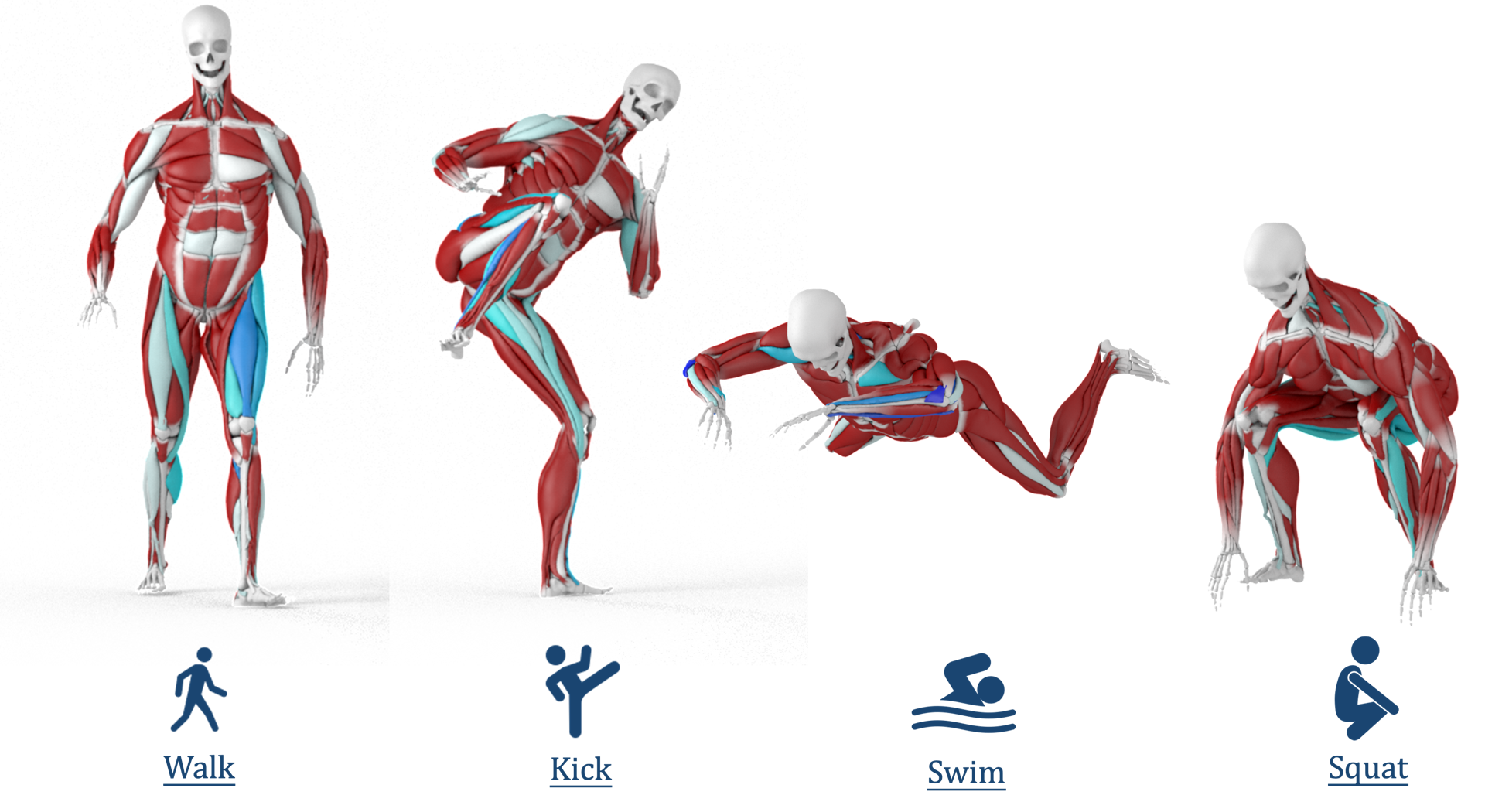
Body deformation caused by muscle contraction and extension plays a vital role in visual realism in games and movies, yet in most 3D animation pipelines artists have to manually specify the muscle activation, which is time-consuming and lacks physical realism. To address this, we build a system in which an RL-based controller, trained on a 1D Hill-type surrogate, discovers per-muscle activations that track reference motions without manual tuning; the same Hill-type constitutive law then drives a 3D volumetric simulator to produce realistic muscle deformation. To achieve stable, efficient, and realistic simulation, we solve Extended Position-Based Dynamics (XPBD) within a Geometric Multigrid (GMG) scheme built on cascaded cages with barycentric-coordinate prolongation. Within this GPU-parallelized solver, we inject the same Hill-type force-length law as an energy-based fiber constraint that turns per-fiber activation into realistic muscle contraction and bulging. We demonstrate volumetric muscle simulation on a 194-muscle human body with a diverse set of motions (walk, kick, swim, overhead-squat, etc.), simulating the full-body model at 18 ms per frame on a single RTX 4090.
Video
Full supplementary video (9:20). Download MP4 (26 MB)
Pipeline
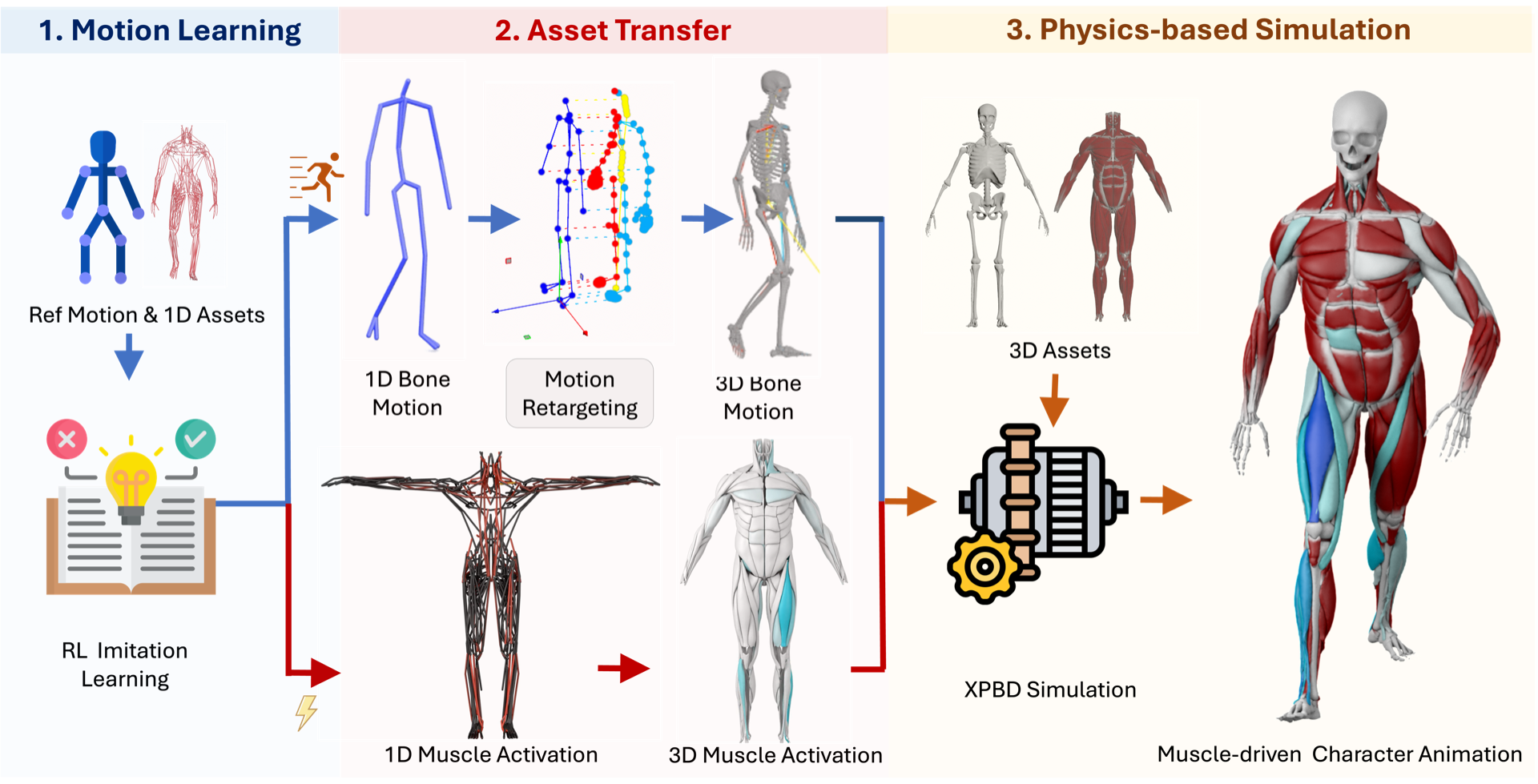
RL imitation learning runs entirely on the 1D asset; retargeting and muscle mapping then lift its output to a 3D skeleton and per-fiber activations, which the XPBD engine simulates in a single forward pass.
RL Pipeline
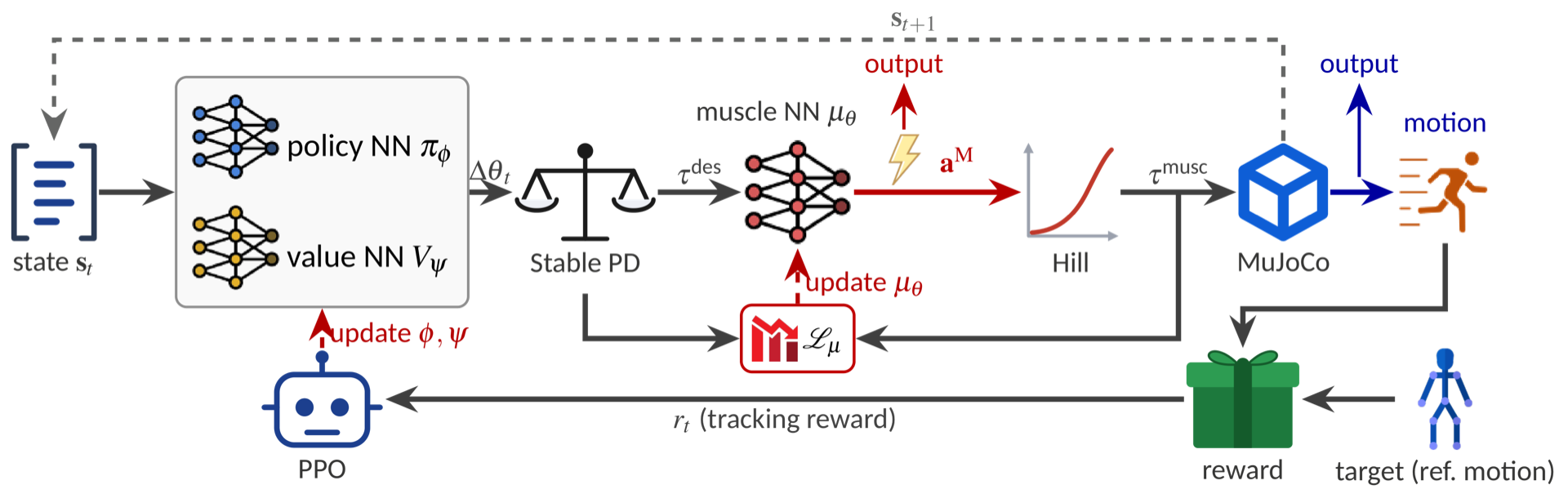
The RL imitation learning stage opened up. A per-joint PD-target offset Δθt is mapped through Stable PD and the muscle network to Nm = 284 activations aM ∈ [0, 1]Nm. Both losses (dashed red) are evaluated each iteration, so πφ and μθ are co-trained in a single PPO loop rather than learned sequentially. The stage has two outputs: the 1D bone motion (blue) and the 1D muscle activation aM (red).
Fiber Constraint
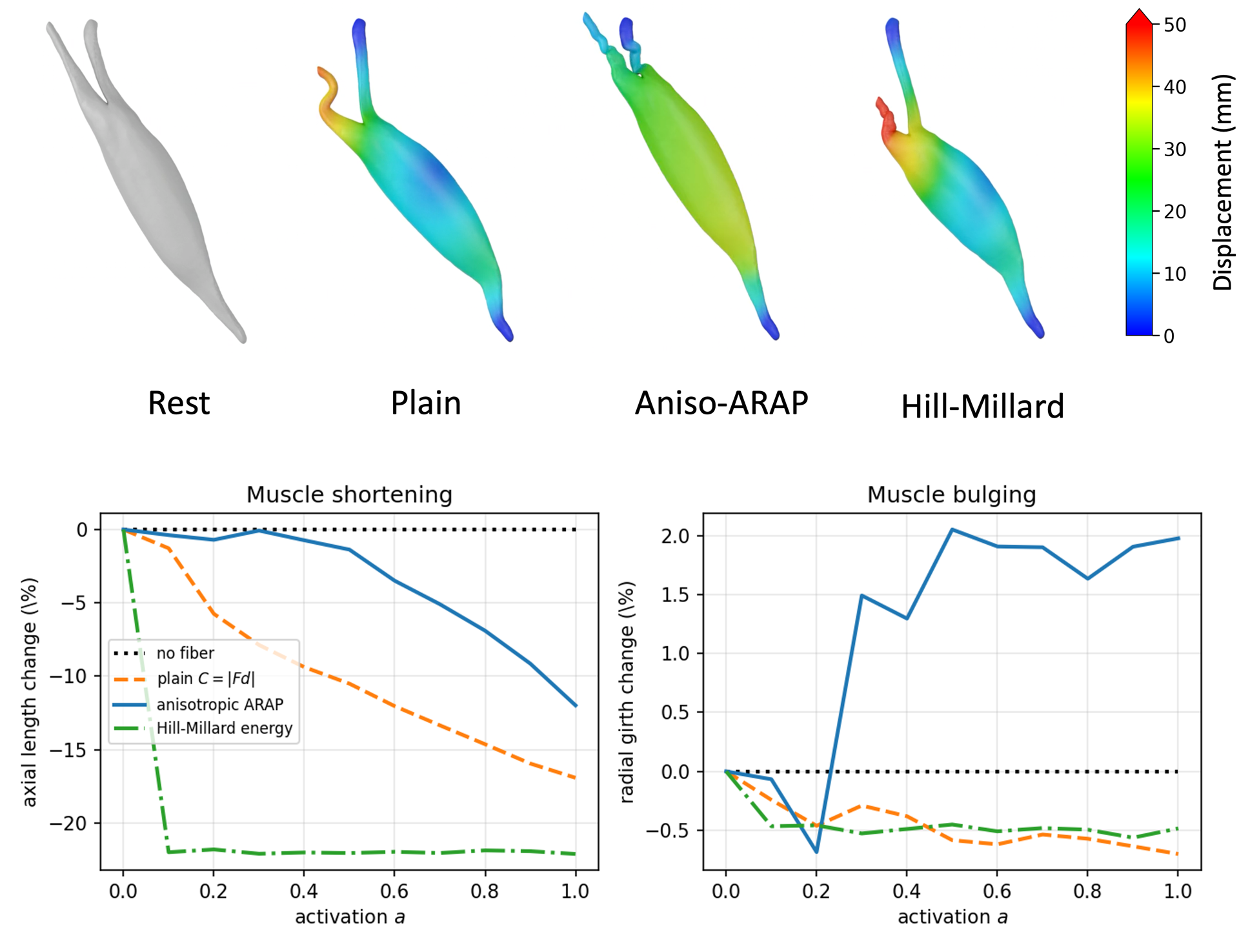
Effect of the four fiber constraints on the biceps. Top: deformed biceps at full activation (a = 1), colored by displacement from the no-fiber baseline. Bottom: axial length (left) and radial girth (right) vs. activation.
Comparison against Houdini's Otis Solver
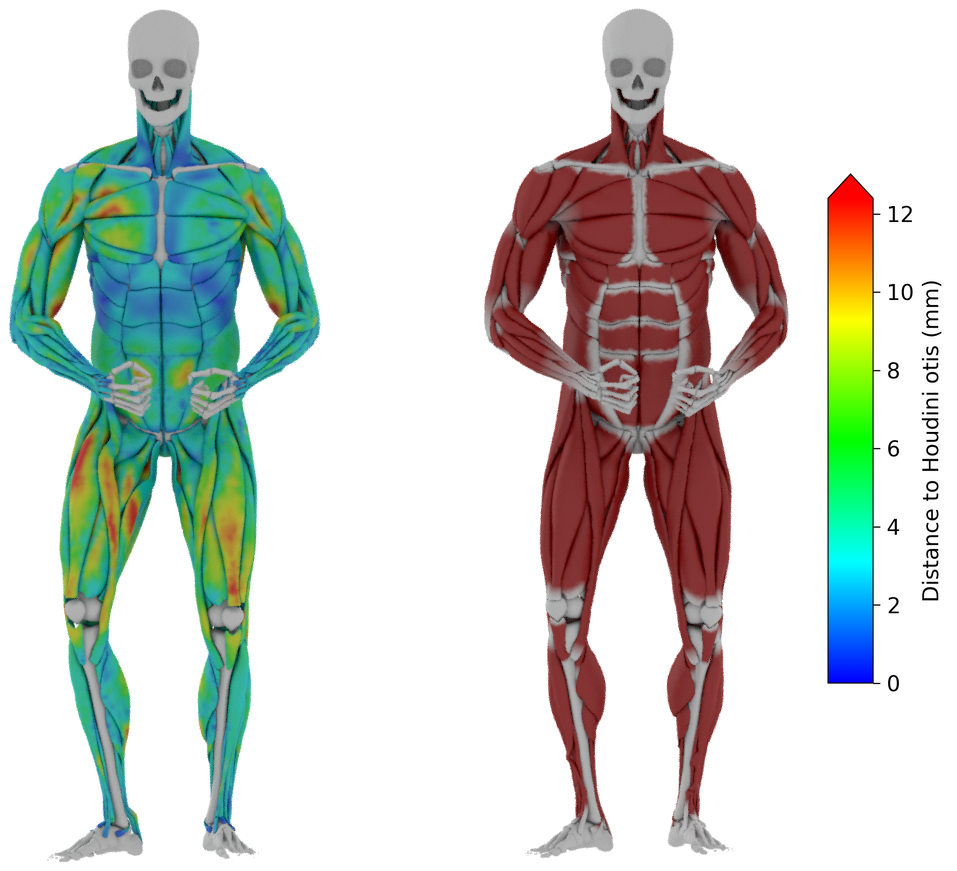
Comparison against Houdini's Otis solver on the same pose. Left: our result, colored by per-vertex distance (mm) to the Otis reference (right); the distance stays within a few millimeters over most of the body. Our solver runs at 18 ms/frame against Otis's 20.8 s/frame.
Comparison against Epic's Neural Musculoskeletal Model
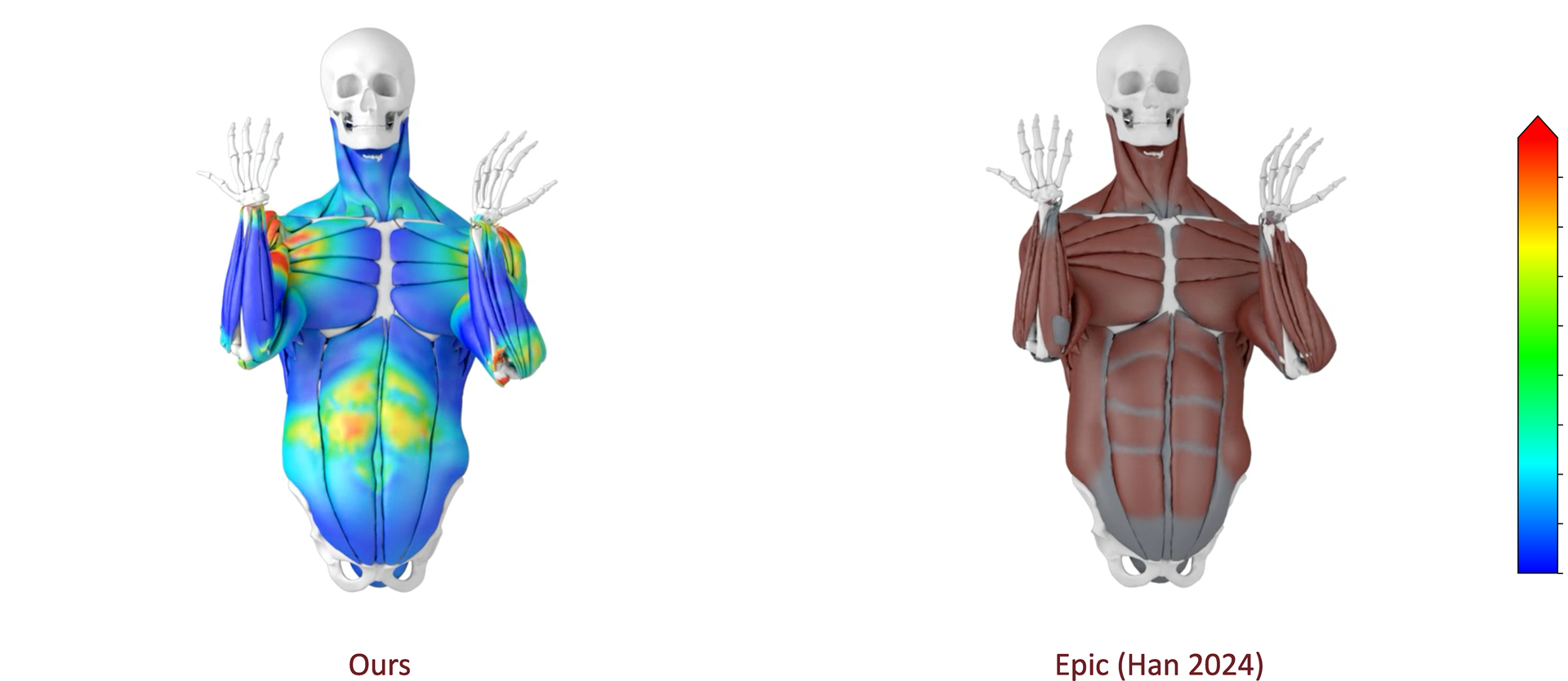
Comparison against the neural musculoskeletal model of Han et al. (Epic) on the same pose. Left: our result, colored by per-vertex distance to their reference (right).
Multigrid
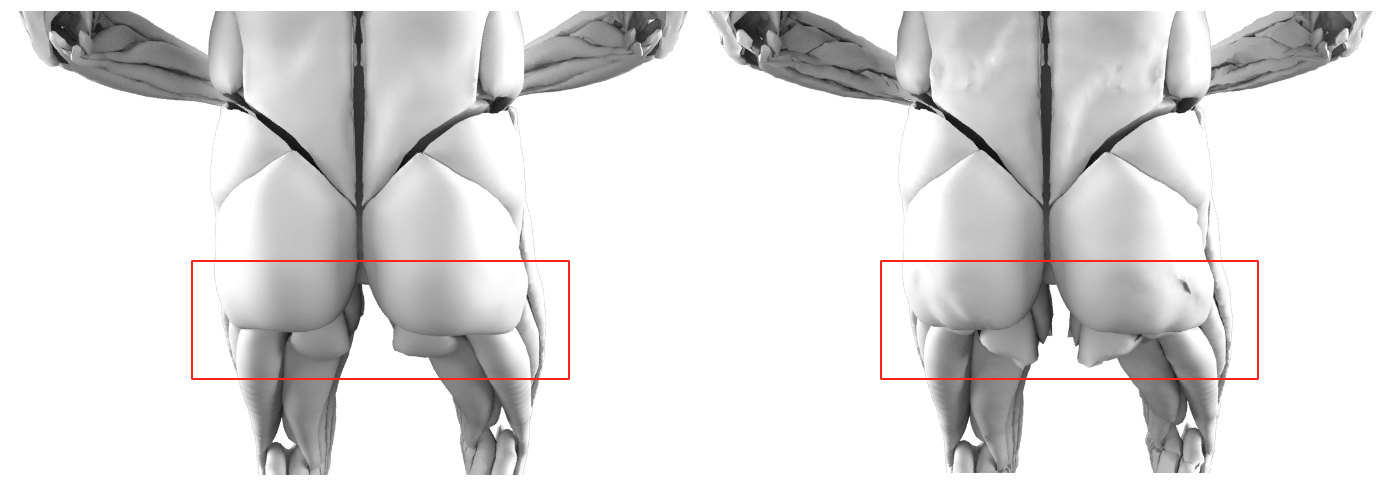
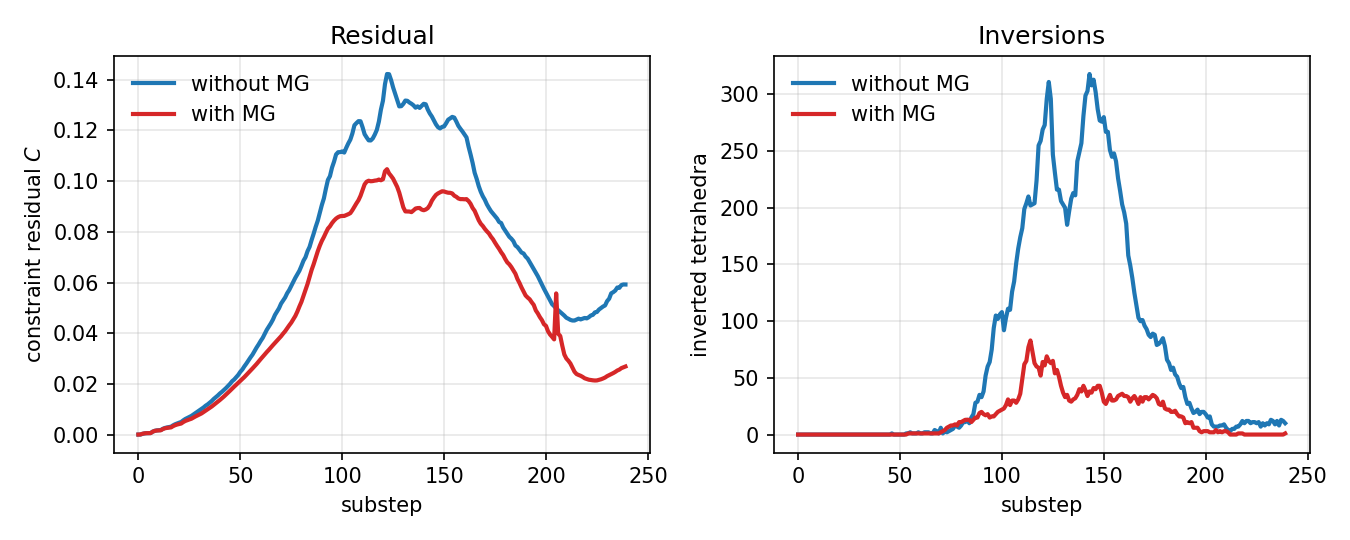
Multigrid (MG) on the full-body volumetric muscle, with (left) and without (right). Top: deformation under the high stiffness needed for realistic behavior. Bottom: constraint residual (left) and inverted-tetrahedron count per substep (right).
Squashed-Bunny Benchmark
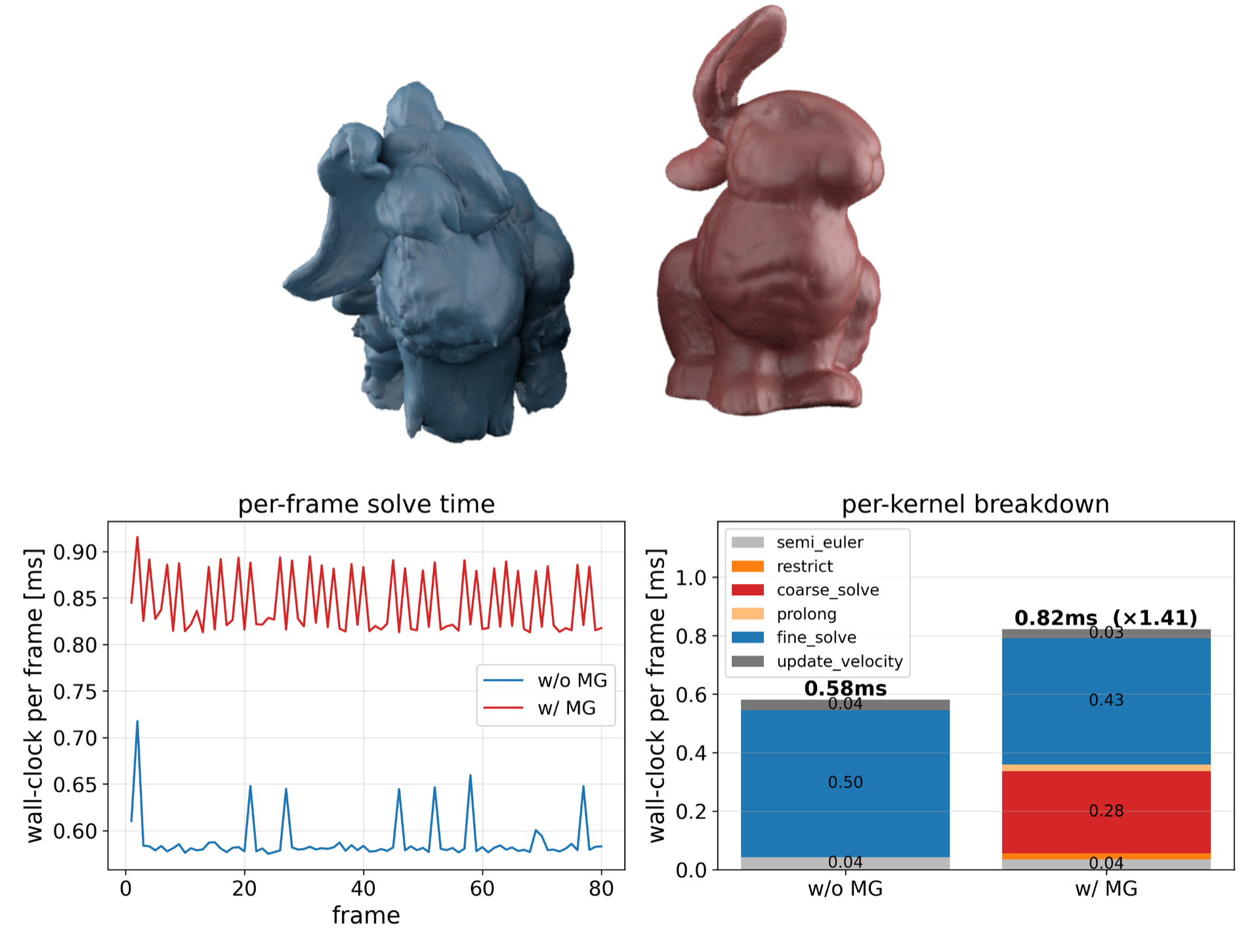
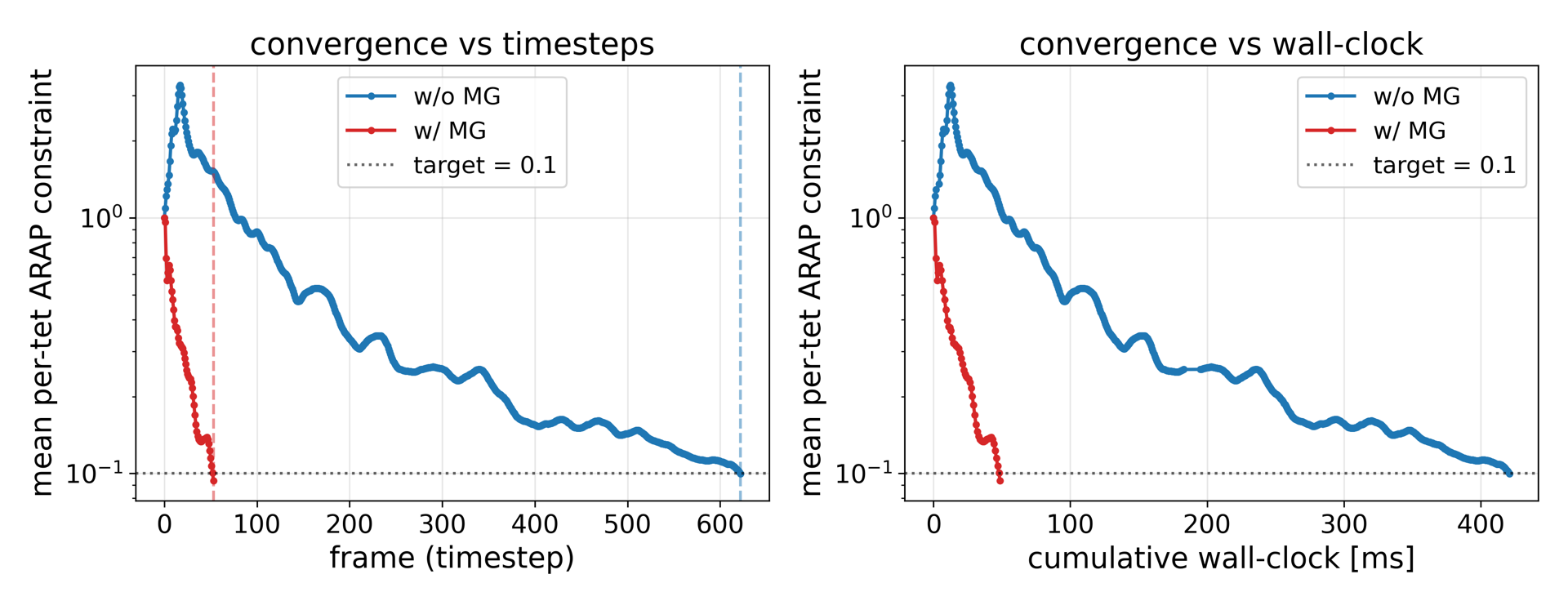
Squashed-bunny benchmark, with (red) vs. without (blue) multigrid (MG) under identical parameters. The bunny is squashed, then released. Top: recovered shape at the same frame (53). Middle: per-frame timing. Bottom: residual history against timesteps and wall-clock. MG converges much faster with a minor per-frame overhead.
Muscle–Bone Collision
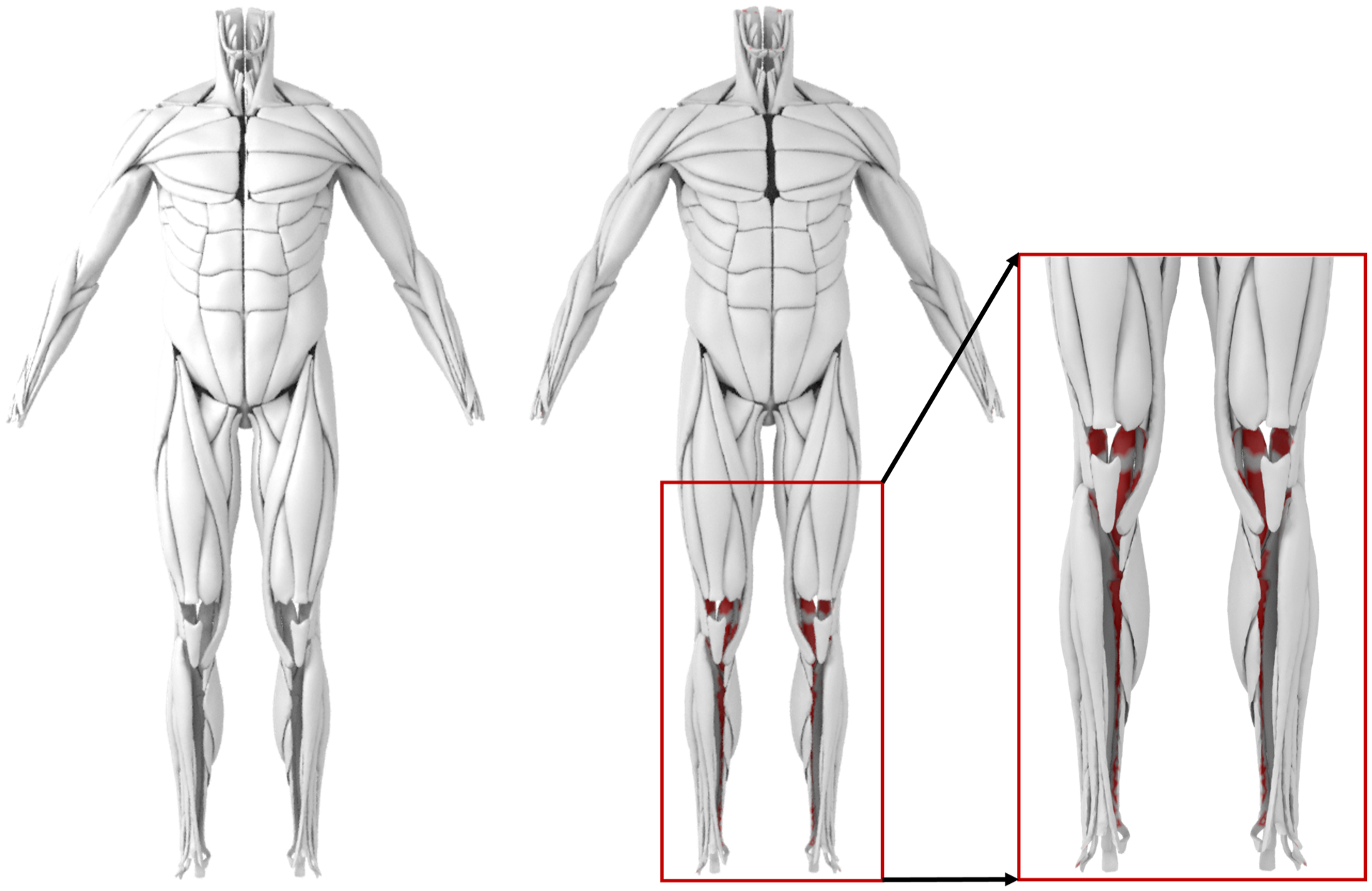
Effect of collision handling, with (left) and without (right). Red marks the vertices penetrating the bone.
Performance
| Quantity | Value |
|---|---|
| GPU | RTX 4090 |
| Features | collision, multigrid, fiber |
| Substeps | 10 |
| Timestep Δt | 1/24 s |
| Vertices | 172,717 |
| Tetrahedra | 468,162 |
| Simulation (no export) | 18 ms/frame |
| collision / other | 11 ms / 7 ms per frame |
| Simulation (USD export) | 32 ms/frame |
| Peak GPU memory | ≈ 98 MiB |
Runtime of the full-body volumetric simulation over 50 frames. Peak GPU memory excludes the ≈ 386 MiB CUDA/Warp context.
BibTeX
@article{Li2026RLMuscle,
  title={RLMuscle: Muscle-Driven Character Animation via Reinforcement Learning},
  author={Li, Chunlei and Yu, Siyuan and Gao, Yang and Li, Shuai and Yu, Peng and Hao, Aimin and Wang, He},
  year={2026}
}